
Parker Fischer · 27 September 2026
Synchronization Techniques in Junotero That Support Consistent Data Integrity for International Teams
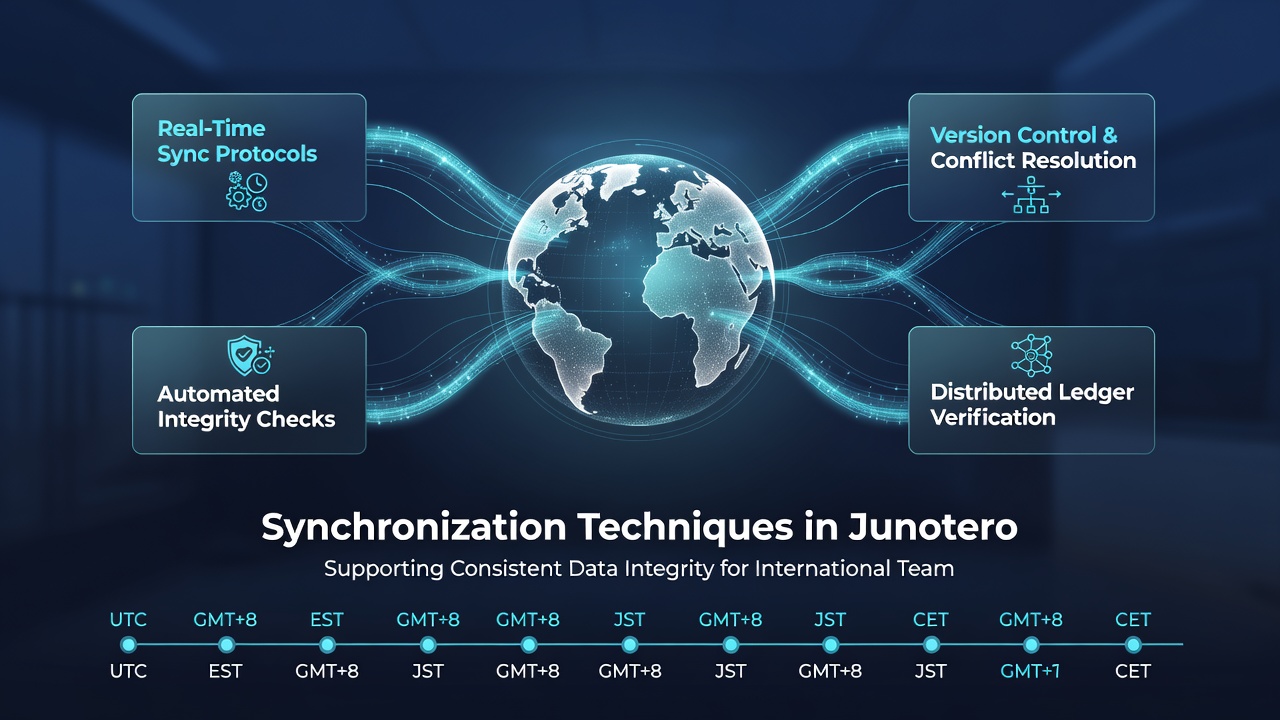
Junotero employs a suite of synchronization techniques designed to maintain consistent data integrity across distributed international teams, where users collaborate on shared note environments from multiple time zones and regulatory jurisdictions, and these methods draw from established distributed systems principles while incorporating platform-specific adaptations for collaborative workflows.
Core Synchronization Protocols in Practice
Operational transformation forms one foundational layer in Junotero, where concurrent edits from team members undergo algorithmic adjustments that preserve intended changes without overwriting data, and this approach handles latency variations by queuing operations at regional nodes before merging them into a unified state, according to documentation on distributed collaboration frameworks. Conflict-free replicated data types, commonly abbreviated as CRDTs, complement this process by enabling each replica to converge independently toward identical outcomes, even during network partitions, while researchers at institutions studying large-scale note systems have documented their effectiveness in environments with high edit volumes.
Version vector tracking adds another dimension by assigning unique identifiers to every update, allowing the platform to detect and resolve divergences that arise from simultaneous contributions across continents, and data shows that this mechanism reduces reconciliation time compared to simpler timestamp methods when teams operate in regions with inconsistent connectivity. In September 2026 Junotero integrated enhanced CRDT extensions that incorporate metadata for compliance tagging, which supports teams navigating varying data residency requirements without interrupting sync flows.
Integrity Verification Mechanisms
Hash-based integrity checks run at regular intervals during synchronization, generating cryptographic summaries of note content that get compared across nodes to flag any tampering or corruption introduced during transmission, and this verification occurs transparently so that international participants experience uninterrupted access. Experts have observed that combining these hashes with Merkle tree structures allows efficient detection of discrepancies in large document collections, particularly when teams in Asia, Europe, and the Americas edit overlapping sections simultaneously.
Encryption layers wrap all transmitted payloads, using end-to-end protocols that keep data unreadable to intermediaries while still permitting the necessary transformations for conflict resolution, and figures from industry reports indicate that such measures align with global standards for protecting collaborative data stores. One case where experts found these techniques effective involved a multinational research group that maintained unbroken note consistency across six countries during a major platform update cycle.
Handling Latency and Regional Challenges
Edge caching nodes positioned strategically around the world buffer synchronization requests, which reduces round-trip delays for users far from central servers while still propagating changes back through the primary mesh, and this setup proves especially useful for teams spanning Australia and North America where time differences affect peak activity periods. Adaptive throttling adjusts sync frequency based on detected network conditions, preventing overload during high-traffic windows without sacrificing eventual consistency guarantees.
Regulatory alignment features allow administrators to configure sync paths that respect jurisdiction-specific rules, routing certain datasets through approved regional gateways, and evidence from compliance audits reveals that these configurations help organizations meet obligations under frameworks like those outlined by the National Institute of Standards and Technology. What's interesting is how the system logs these routing decisions automatically, creating audit trails that international teams can reference during reviews.
Future-Ready Extensions and Team Applications
Peer-to-peer fallback modes activate when centralized coordination faces temporary disruptions, enabling direct device-to-device exchanges that still feed into the main ledger once connectivity resumes, and this redundancy has supported continuity for distributed groups working on time-sensitive projects. Integration with external identity providers adds another safeguard by tying edit permissions to verified accounts, which minimizes risks of unauthorized alterations during sync events.
Teams in sectors such as software development and academic research have adopted these techniques to coordinate across borders, with observers noting measurable improvements in data coherence when multiple contributors work on the same note collections daily. National Institute of Standards and Technology guidelines provide relevant benchmarks that Junotero implementations reference for integrity practices, while a separate analysis from the Australian Computer Society highlights similar distributed approaches in regional collaborative tools.
Conclusion
Overall, the synchronization techniques embedded in Junotero deliver structured support for data integrity in international team settings by combining established algorithms with platform-specific routing and verification steps, and ongoing refinements continue to address emerging requirements from global user bases operating under diverse conditions.