Jordan Lang · 11 October 2026
Leveraging Semantic Linking Strategies to Enhance Connectivity in Group Idea Repositories
Group idea repositories have grown into central hubs for collaborative work across research teams, corporate innovation groups, and cross-functional projects where participants collect, refine, and connect concepts over time. Semantic linking strategies add structured relationships between entries so users can trace conceptual paths rather than relying on simple keyword matches or folder hierarchies. These approaches draw on natural language processing techniques that identify meaning-based connections, allowing related ideas to surface automatically when new content enters the system.
Core Components of Semantic Linking in Shared Repositories
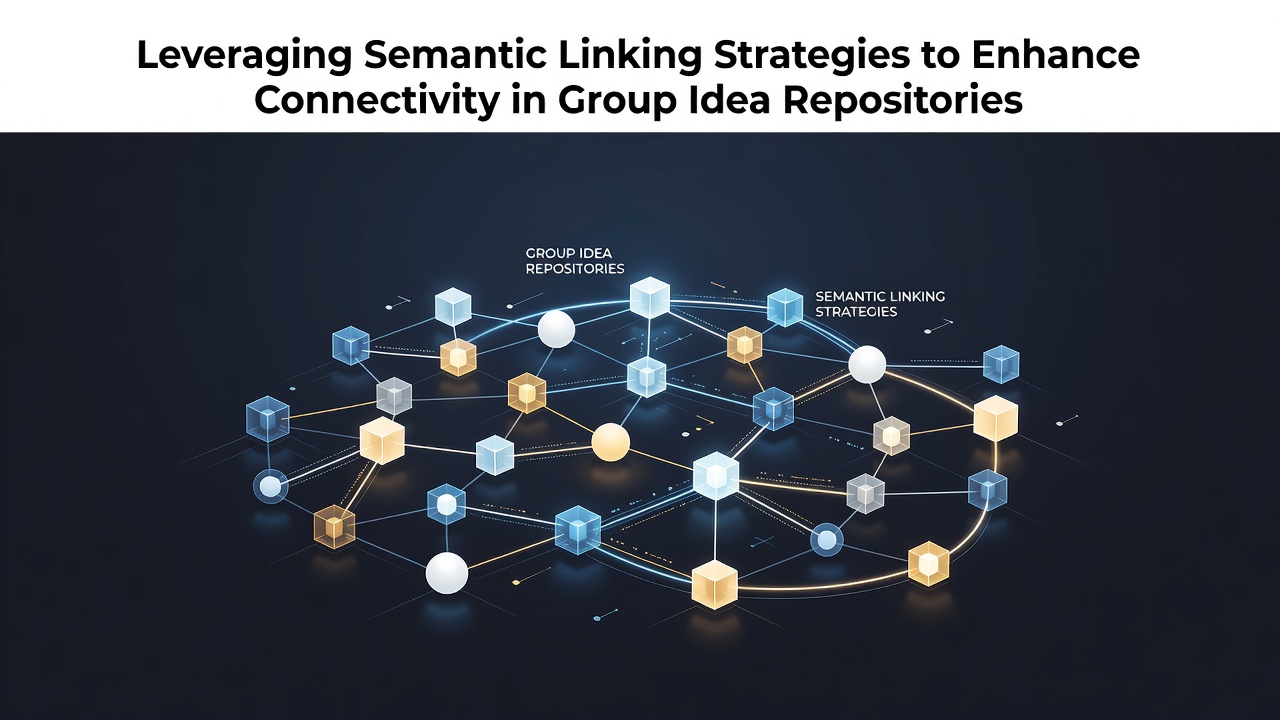
Researchers at several academic institutions have mapped how ontology-based tags, entity recognition, and vector embeddings work together to build these connections. A repository stores individual notes or documents as nodes while semantic layers assign weighted edges based on topical overlap, causal references, or hierarchical relationships. Data from collaborative platforms shows that repositories using at least three layers of semantic annotation experience measurable increases in cross-entry navigation rates compared with text-search-only systems.
Implementation often begins with automated processing that extracts key entities and relationships from incoming contributions. Teams then apply manual review rounds to validate or adjust the suggested links before they become visible to all users. In October 2026 several European research consortia plan to release updated benchmarks on link accuracy rates after incorporating multilingual models trained on non-English technical corpora, which should improve performance for international groups that contribute content in more than one language.
Practical Strategies Teams Apply Today
One effective method involves creating controlled vocabularies that map domain-specific terms to broader concepts. When a contributor adds a note containing the phrase "circular supply chain," the system can link it automatically to entries discussing resource loops, waste reduction metrics, and closed-loop manufacturing case studies. Another technique uses temporal semantic links that connect ideas based on their evolution over project phases, helping later participants understand how early assumptions influenced later decisions.
Integration with external data sources further strengthens connectivity. For instance, repositories can reference standardized identifiers from public research registries maintained by organizations such as the National Institute of Standards and Technology in the United States or similar bodies in Canada and Australia. These references allow users to trace an internal idea back to published studies or regulatory frameworks without leaving the platform environment.
Observed Effects on Group Connectivity
Studies conducted by university labs in multiple countries indicate that semantic linking reduces duplicate work because contributors can quickly locate prior discussions of similar concepts. Navigation logs from enterprise deployments reveal that users follow semantic trails more frequently than folder structures when searching for precedent materials. Connectivity metrics also rise when teams establish link review cycles at regular intervals, preventing outdated associations from persisting after project scopes shift.

Cross-border teams report additional gains when semantic systems account for regional terminology differences. A note written in British English about "sustainable procurement" can link to an Australian entry using "responsible sourcing" once the underlying concept vectors align. Observers note that such alignment becomes especially valuable during joint grant applications or multi-site product development cycles where contributors must synthesize input from dispersed locations.
Technical Considerations for Implementation
Platform architects typically evaluate embedding models for their ability to handle domain jargon while maintaining reasonable compute requirements. Vector databases store the resulting representations so nearest-neighbor queries can surface candidate links in real time. Access controls must extend to the link layer itself, since some relationships may carry sensitivity levels different from the source notes. Audit trails that record when links were created, edited, or removed help maintain transparency across large contributor groups.
Testing protocols often include both quantitative measures, such as precision and recall of suggested connections, and qualitative feedback from users who rate the usefulness of surfaced relationships. Reports from industry consortia show that iterative refinement cycles, conducted quarterly, keep link quality stable even as repository size grows into the tens of thousands of entries.
Conclusion
Semantic linking strategies continue to evolve alongside advances in language models and ontology standards, offering groups structured ways to surface connections that keyword searches alone cannot reveal. Organizations that adopt these methods gain improved navigation paths, reduced redundancy, and stronger continuity across distributed contributors. As benchmarks scheduled for release in late 2026 become available, teams will have clearer data on how multilingual and cross-domain linking performs at scale.