Jordan Lang · 8 November 2026
Examining Automated Tagging Systems That Organize Collective Brainstorming Outputs Across Distributed Groups
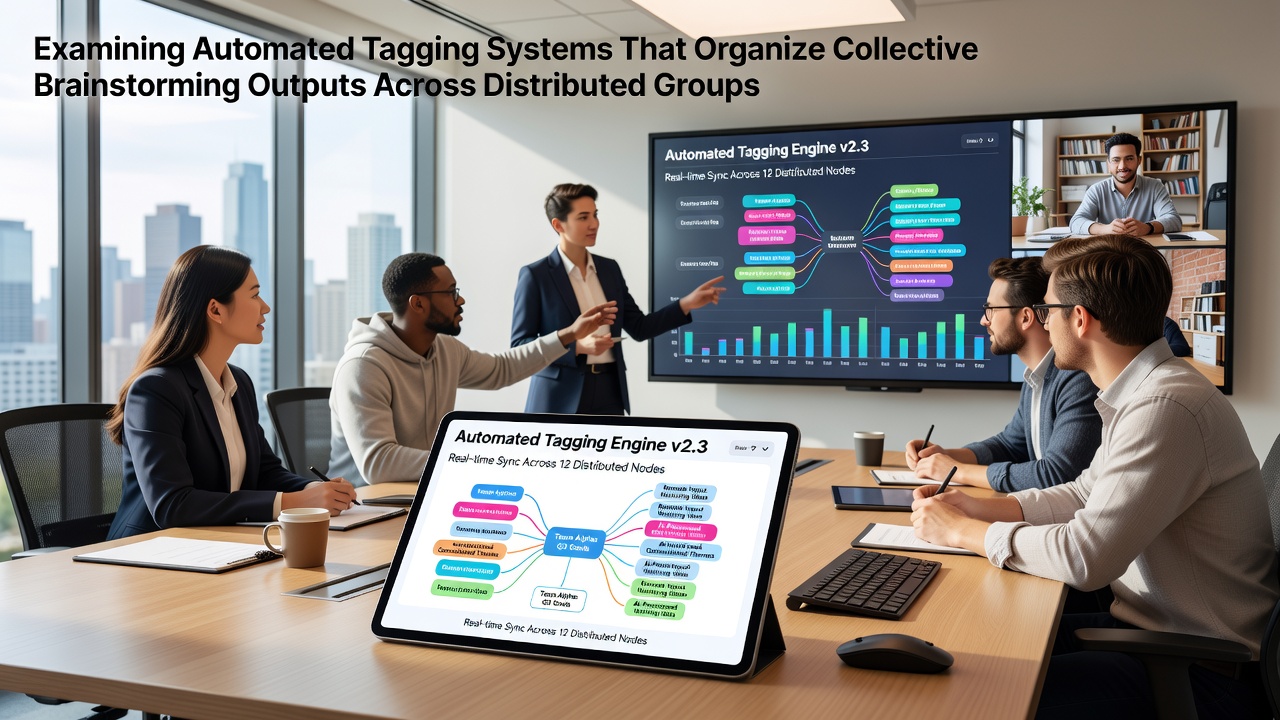
Automated tagging systems process large volumes of ideas generated during collective brainstorming sessions that involve participants spread across multiple locations and time zones. These tools apply natural language processing algorithms along with machine learning models to assign descriptive labels that group related concepts together and make retrieval more efficient for teams working remotely.
Researchers at various institutions have documented how such systems analyze text inputs from chat logs, shared documents, and virtual whiteboards to extract keywords, themes, and relationships. In November 2026 the International Organization for Standardization published revised guidelines on metadata practices that directly address tagging consistency in collaborative environments, and organizations began integrating those recommendations into their platforms.
Core Mechanisms Behind Tagging Automation
Systems rely on semantic analysis to identify context rather than simple keyword matching, which allows them to connect ideas that use different wording yet address the same underlying topic. Clustering techniques group outputs into categories such as feasibility, innovation level, or resource requirements while preserving the original phrasing contributed by each participant. Data from multiple sessions feed into training datasets that improve accuracy over successive cycles, and studies from the University of Melbourne have shown measurable gains in search precision after three months of continuous use.
Integration with version control features tracks how tags evolve when new contributions arrive, and this process supports distributed groups that add material at irregular intervals. National Institute of Standards and Technology reports outline recommended protocols for maintaining tag integrity when teams operate across different regulatory jurisdictions.
Implementation Patterns in Global Teams
Organizations deploy these systems through cloud-based services that synchronize inputs in real time, and the resulting tagged repositories become accessible via role-based permissions. One documented case involved a multinational engineering group that reduced time spent locating prior discussion threads by 40 percent after introducing automated categorization. Another example from a Canadian research consortium demonstrated how tags enabled cross-project comparisons that had previously required manual review of thousands of entries.

Privacy considerations receive attention because tagging processes often retain contextual snippets alongside labels. European data protection authorities have issued guidance that requires explicit consent mechanisms when personal identifiers appear in brainstorming content, and similar frameworks have emerged in Australia through the Office of the Australian Information Commissioner.
Performance Metrics and Evaluation Methods
Accuracy rates vary depending on domain specificity and input quality, yet aggregated figures from industry surveys indicate that well-configured systems achieve F1 scores above 0.82 on standardized test sets. Observers note that performance improves when teams provide initial seed tags that guide the model during early deployment phases. Longitudinal data collected by academic groups reveal that tag stability increases after the first six months as the system encounters repeated patterns across successive projects.
Evaluation protocols typically combine automated benchmarks with human review panels that assess whether assigned tags reflect the intended meaning of each contribution. These panels operate under blind conditions to reduce bias, and results feed back into model refinement cycles. The approach supports continuous improvement without disrupting ongoing group activities.
Conclusion
Automated tagging systems continue to evolve as distributed collaboration becomes standard practice across sectors. Updated standards released in November 2026 provide clearer benchmarks for implementation, and ongoing research from multiple regions supplies evidence on effective deployment strategies. Organizations that adopt these tools gain structured access to collective outputs while maintaining traceability of original contributions.